

Zero-interest trap: What you should do with high CHF liquidity now
The interest rate decisions of the Swiss National Bank (SNB) have fundamentally changed the environment for investors: conventional bank accounts offer almost no interest, while inflation continuously erodes purchasing power. Anyone leaving significant cash holdings of CHF 500,000 or more in savings accounts is suffering a continuous real loss of wealth. Consequently, high-net-worth individuals are focusing intensely on the strategic allocation of large cash reserves.
Unreflective action—such as the hasty purchase of unsuitable financial products or simply leaving cash idle—proves to be a structural disadvantage to returns upon closer inspection. While inaction leads to creeping losses, unstructured risk-taking poses dangers to the substance of one's wealth. Sound wealth structuring provides the necessary guidance to organize liquidity purposefully and efficiently tap into yield potential within the CHF market.
Key takeaways at a glance:
- The zero-interest dilemma: The SNB's monetary policy leads to a steady real loss of purchasing power for uninvested cash holdings in savings accounts.
- The investment mechanism: By systematically dividing capital into tactical liquidity and income-generating investment components, capital is protected against devaluation without restricting the necessary flexibility.
- The real return margin: With a structured portfolio allocation, current income from high-quality Swiss stocks and bonds consistently exceeds cash costs and the inflation rate.
- Risk management:A precise requirement profile ensures that adequate risk buffers are maintained to systematically limit loss risks during volatile market phases.
The liquidity paradox: Why waiting in a savings account is the most expensive option
The core problem for many investors in the current SNB environment is the perceived safety of holding cash. Large balances provide a sense of security but silently incur opportunity and real costs:
- Purchasing power loss due to zero interest: Sight deposits and savings accounts yield a negative real return after accounting for inflation and bank fees. Capital shrinks continuously.
- Lost earnings: Anyone keeping CHF 500,000 or more in liquid form is missing out on reliable dividends and distributions from tangible assets.
- The timing trap: Fearing market volatility, investors often wait years for the "perfect moment" to enter the market—missing out on the long-term power of compounding in the process.
A professional wealth strategy resolves this conflict by creating a structured balance between liquid reserves and profitable real assets.
The yield arbitrage: Cash returns vs. real asset performance
When evaluating CHF liquidity, financial analysis compares the effective interest rate of account balances (icash) with the expected total return (Rportfolio) with a balanced investment structure.
If the current distribution and capital appreciation yield (Rdiv) of a Swiss quality portfolio exceeds the returns on cash reserves, a positive added value (Snet):
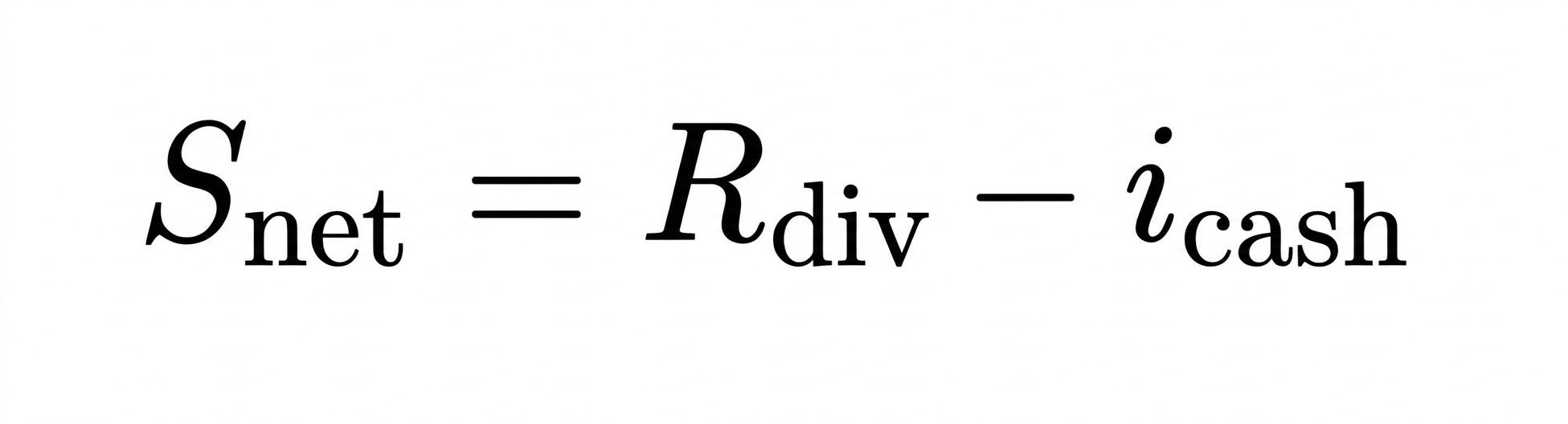
If a significant portion of the returns consists of tax-optimized dividends or distributions from capital contribution reserves (CCR), this effect is amplified in terms of net performance after taxes. The investor protects their capital against the creeping devaluation in the Swiss franc environment, while the assets work actively to preserve value.
Direct comparison: Holding cash vs. a structured investment strategy
To understand the strategic consequences of both approaches when holding high levels of liquidity from CHF 500,000, the following overview is provided:
- Substance preservation
- Cash / Bank account: Constant loss of purchasing power due to inflation and zero interest rates.
- Independent wealth management: Long-term preservation of substance and protection of real purchasing power.
- Cash flow (dividends)
- Cash / Bank account: Zero to negligible in the current SNB environment.
- Independent asset management: Regular income through dividends and bond interest.
- Market timing risk
- Cash / Bank account: High (risk of missing market opportunities due to inaction).
- Independent asset management: Managed (planned, staggered building and expansion of positions).
- Flexibility
- Cash / Bank account: Very high, but associated with guaranteed real costs.
- Independent asset management: High (integrated liquidity reserve for short-term needs).
- Risk profile
- Cash / Bank account: Illusory security; concentration risk in bank deposits / inflation.
- Independent asset management: Broadly diversified across asset classes and Swiss quality stocks.
Asset classes for optimizing high CHF liquidity
To structure substantial cash reserves in the Swiss franc environment, various asset classes with specific risk profiles and return characteristics are available:
- Money market funds (CHF)
- Expected return: Low (aligned with the key interest rate).
- Risk level: Very low.
- Role in the portfolio: Tactical parking of liquidity with high availability.
- Medium-term notes
- Expected return: Moderate (fixed commitment).
- Risk level: Very low (issuer risk).
- Role in the portfolio: Predictable return for a fixed time horizon.
- Swiss equities
- Expected return: Attractive (dividends and growth).
- Risk level: Moderate to high.
- Role in the portfolio: Long-term capital preservation and continuous cash flow through quality stocks.
- Gold (CHF-hedged)
- Expected return: Store of value (no ongoing income).
- Risk level: Moderate (price fluctuations).
- Role in the portfolio: Hedging against geopolitical risks and currency devaluation.
Three tactical approaches to asset allocation
Depending on an individual's risk profile and investment horizon, there are three structured implementation strategies available for high-net-worth individuals:
1. The staggered approach (cost-average strategy): Gradual build-up of target positions over 6 to 18 months to reduce market entry risk during volatile market phases.
2. The core-satellite model: A combination of a broadly diversified, income-oriented core portfolio (Swiss bonds and quality stocks) and focused satellite components for yield optimization.
3. The three-tier liquidity pyramid: Allocation of capital into operational liquidity (account balances), tactical reserves (money market funds/cash bonds), and long-term growth capital (real assets).
Risk management: The arithmetic of structured asset allocation
As attractive as yield alternatives to cash may be, disciplined risk management is just as important. Impulsive shifts into highly volatile assets carry significant risks of loss—especially when entering the market without regard for personal risk tolerance and market cycles.
Professional risk management protects your capital with three clear guardrails:
- Clear liquidity budgeting: Instead of an all-or-nothing approach to cash, the actual liquidity requirement for the next 12 to 36 months is determined and securely set aside.
- Stress testing and scenario analysis: The target portfolio is subjected to changing SNB interest rate developments and market shocks to ensure that the strategy remains viable even in a bear market.
- Quality diversification: Only top-tier Swiss stocks, solid bonds, and inflation-hedging assets serve as investment building blocks. Opaque or illiquid niche products are consistently avoided.
Independent representation against banks in a zero-interest environment
In the current interest rate environment, banking institutions sometimes tend to favor proprietary, fee-intensive investment products. An independent asset manager consistently represents the client's interests in this context:
He objectively evaluates the optimal investment alternatives in the CHF space, negotiates institutional terms with custodian banks, and ensures that the asset structure is precisely tailored to your individual overall situation, free from conflicts of interest.
Protecting substance, preserving purchasing power: Optimize your CHF liquidity now
Realignment of high cash holdings in the Swiss franc environment from CHF 500,000 requires far more than the spontaneous purchase of individual securities. It demands a deep understanding of real returns, risk diversification, and uncompromising risk management that sustainably protects your capital from devaluation.
Format Vermögen & Anlagen AG supports you at our locations inZurich, St. Gallen, Basel and Lucerne with bank-independent expertise to position your assets profitably and robustly. Our track record shows that our risk-adjusted approach consistently ranks at the top in long-term comparisons. latest awards 2026. We analyze your cash position, develop customized alternatives, and seamlessly integrate yield-generating components into your overall investment strategy – transparently and free from in-house product interests.
→ Schedule your free, no-obligation initial consultation today, tailored specifically to your asset structure initial consultation.



Format Vermögen & Anlagen AG holds a FINMA license as a wealth & asset manager for collective investment schemes.


